
Key Takeaways
- 1. Modern warehousing is a critical supply chain hub, not just a storage space Efficient warehouses help businesses manage inventory flow, maintain accurate stock levels, improve order fulfillment, and ensure timely delivery to customers, directly impacting operational reliability and customer satisfaction.
- 2. Technology-driven warehouse management improves visibility and accuracy Advanced Warehouse Management Systems (WMS), barcode scanning, RFID tracking, and real-time inventory monitoring help businesses reduce errors, prevent stock shortages, and optimize inventory planning.
- 3. Efficient order fulfillment directly influences customer experience Fast picking, accurate packing, proper labeling, and timely carrier coordination ensure customers receive the correct products on time and in good condition, helping businesses improve retention and brand reputation.
- 4. Strategic warehouse location and scalable storage solutions reduce logistics costs Properly located warehouses minimize transportation expenses, improve delivery speed, and support efficient import-export operations. Scalable warehousing allows businesses to adjust storage capacity based on seasonal or operational demand.
- 5. Smart warehousing supports compliance and faster supply chain movement Features like customs-compliant storage, bonded warehousing, and cross-docking help businesses handle international trade requirements efficiently while reducing storage time, operational delays, and unnecessary handling costs.
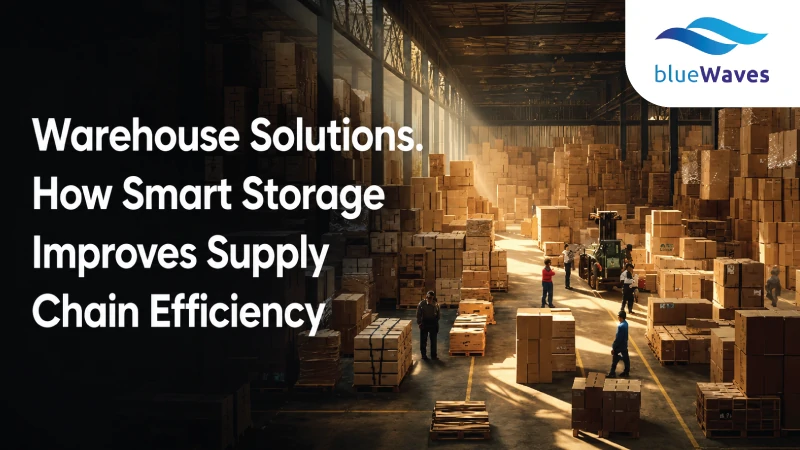
In today’s competitive business environment, efficient warehouse management has become one of the most important elements of a successful supply chain. Companies across industries are constantly looking for ways to optimize storage, reduce operational delays, and improve inventory visibility. Smart warehouse solutions have transformed traditional storage facilities into highly organized, technology-driven spaces that support faster and more accurate supply chain operations.
Businesses that invest in modern warehousing strategies gain significant advantages in inventory control, order fulfillment, and customer satisfaction. With rising market demand and increasing customer expectations, selecting the right warehousing partner has become a critical business decision. Bluewaves Logistics delivers advanced storage and warehousing solutions that help businesses streamline their operations and improve overall supply chain performance.
As one of the trusted providers of Warehouse Logistics Services in India, Bluewaves Logistics offers customized warehouse management systems designed to support businesses of all sizes. With specialized expertise in Warehouse Logistics Services in Ahmedabad, the company provides scalable storage solutions that improve operational productivity and reduce logistics costs.
The Warehouse’s Real Role in the Supply Chain
A warehouse, on paper, is a building where goods are stored. But that description undersells what a well-run logistics warehouse actually does. Think of it as the hub in your supply chain wheel. Goods come in from manufacturers, suppliers, or ports — often in bulk, often on irregular schedules. Orders go out to customers, distributors, or retail channels — often in varied quantities, often under time pressure. The warehouse is what sits between these two realities, absorbing the variability on the inbound side and delivering consistency on the outbound side.
When that hub functions well, goods are received, checked, and stored correctly. Stock levels are accurate. Orders are picked up and packed efficiently. Shipments leave on time. When they expect it, customers receive what they ordered. The whole system moves with a rhythm that makes the business look reliable and professional. When the warehouse is poorly managed — wrong stock counts, slow picking processes, inadequate packing, poor location choice, no customs compliance — everything downstream suffers. Orders are late. Costs escalate. Customer relationships fray. And the business spends more energy managing supply chain firefighting than actually growing.
Warehouse Logistics Services in Ahmedabad play a particularly important role for businesses in Gujarat, where a strong manufacturing and export base means that getting goods from factory to port — and managing stock along the way — is a daily operational reality.
Storage and Inventory Management — Getting the Basics Right
These seem like simple questions, but they carry real operational weight. A business that underestimates its storage needs ends up with congested, disorganized inventory that slows picking times and increases the risk of damage. A business that overestimates lock up capital in space it is not using.
Good Warehouse Logistics Services in India begin with a thorough assessment of the client’s inventory profile — the mix of product types, the seasonal variation in volumes, the average dwell time of goods in storage, and any special handling requirements. From there, the right storage solution — whether short-term, long-term, or a combination — can be structured to match actual needs rather than a generic template.
Inventory management systems are central to this. A modern logistics warehouse uses warehouse management systems (WMS) to track stock in real time — what is on hand, where it is located within the facility, what has been received and what has gone out. For businesses managing multiple SKUs or operating across multiple sales channels, this real-time visibility is not a luxury. It is what prevents stock-outs, overstock situations, and fulfilment errors that damage customer trust.
Order Fulfilment — Where Warehousing and Customer Experience Intersect
Here is something that businesses often miss when they think about warehousing: the warehouse is where your customer’s experience is made or broken. A customer placed an order. That order gets picked from warehouse stock, packed correctly, labelled accurately, and handed over to the carrier. The speed, accuracy, and quality of that process determines whether the customer receives the right product, in good condition, on time — and whether they order again. Slow picking processes, mispicked items, inadequate packing that results in transit damage, or missed carrier cut-off times — all of these happen at the warehouse level, but the customer experiences them as the business’s failure, not the warehouses.
Professional Warehouse Logistics Services in Ahmedabad build order fulfilment processes that are systematic, verifiable, and scalable. Modern warehouses deploy technology at the picking stage — barcode scanning, pick-to-light systems, or digital pick lists — to reduce error rates. Packing standards are defined and followed consistently, matching the packing method to the product’s fragility, weight, and transport mode. Carrier handoffs are scheduled to meet shipping cut-offs without last-minute scrambling. For businesses with high order volumes or diverse product ranges, this systematic approach to fulfilment is what allows them to grow without their error rates growing in parallel.
Location Strategy — Why Where Your Warehouse Sits Matters
A warehouse in the wrong location can cost a business significant money in transport time and freight charges — even if the facility itself is perfectly run. The ideal warehouse location depends on where goods come from, where they are going, and how fast they need to move. For importers, proximity to the entry port — whether sea or air — reduces the time and cost of moving goods from customs clearance to storage. For manufacturers exporting goods, a warehouse located close to the production facility, and the export gateway minimizes double-handling and inland freight costs.
For businesses managing domestic distribution as well as international trade, strategic positioning relative to key customer locations, road networks, and multimodal transport corridors all factor into the location decision. Warehouse Logistics Services in India providers with strategic partnerships across multiple warehouse locations — both domestically and globally — offer clients the flexibility to store goods closer to where they are needed, rather than forcing everything through a single fixed facility regardless of the trade flows involved.
Cross-Docking — Speed Without Storage Costs
Not every shipment needs to be seated in a warehouse waiting to be dispatched. For goods that move on defined schedules — consolidated sea freight coming in from multiple overseas origins and being dispatched to multiple domestic buyers, for example — cross-docking offers a faster, leaner alternative. In a cross-docking operation, inbound cargo is transferred directly from arriving vehicles or containers to outbound transport — with minimal or no storage time in between. The goods touch the warehouse floor briefly, are sorted or consolidated as needed, and move on.
This approach significantly reduces storage costs and speeds up the distribution cycle. It works particularly well for perishable goods, time-sensitive shipments, and high-turnover inventory where long storage times add cost without adding value. Not every warehouse facility offers genuine cross-docking capability — it requires the right physical layout, operational process, and coordination across inbound and outbound transport schedules. When it is available and well-executed, it is a powerful tool for supply chain efficiency.
Customs Compliance Within the Warehouse
For businesses involved in international trade, the warehouse is not just a storage facility — it is also a compliance environment. Imported goods that have cleared customs need to be stored, handled, and dispatched in ways that comply with the conditions of their import clearance. Goods under bonded warehouse status have their own specific documentation and handling requirements. Certain commodities require inspection by regulatory authorities before they can be released from the warehouse — FSSAI inspections for food imports, for instance, or phytosanitary checks for agricultural products.
A logistics warehouse that understands these compliance requirements — and has the documentation processes, physical layout, and operational procedures to support them — saves businesses from compliance failures that can result in penalties, shipment holds or repeat inspections. Warehouse Logistics Services in Ahmedabad integrate customs compliance awareness into their warehouse operations, giving international traders an important layer of protection that purely domestic warehouses often cannot provide.
Scalability — A Warehouse That Grows With Your Business
A common error in warehousing is entering into binding, long-term storage contracts with a warehouse operator because of the current level of activity in a business, only to discover that the volume is increasing more rapidly than anticipated or that the volume varies according to season, meaning they need more space than is available.
Smart warehousing is Scalable warehousing. A third party logistics company that runs a business with multiple facilities can allocate the space and services of a client according to the actual need of the client as per his demand and not as per the contractual agreement. Whether it’s a pre-Diwali production spike, a year-end export drive or a post-monsoon import run, capacity can be ramped up, without the company having to own or lease extra fixed capacity.
This flexibility is one of the most intriguing reasons to choose to outsource warehousing services to a third party logistics company as opposed to operating a warehouse on their own. Capital invested in owned warehouse keeps available for the core business — warehousing is agile and responsive to the actual trade flows.
Technology Integration — Visibility Across the Supply Chain
The best modern logistics warehouses of the day do not simply carry products, they produce data. This all comes from integrated warehouse management systems and digital reporting tools, providing real-time inventory visibility, inbound and outbound tracking, stock movement histories, order status updates and more.
This visibility is a gamechanger for any business with complex supply chains. It enables procurement teams to make informed replenishment plans. It helps the sales team to predict the delivery dates with certainty. It enables the management to identify trends in inventory, slow-moving items, and for ordering and logistics planning decisions.
RFID technology does more: It allows for real-time tracking of individual items or pallets within the warehouse, without having to scan them manually. For companies that must maintain high levels of visibility, tracking is becoming commonplace instead of expensive.
Why Choose us
Bluewaves Logistics provides detailed Warehouse Logistics Services in Ahmedabad and India, where warehousing is not limited to storage; it is about intelligent, integrated supply chain management. Bluewaves Logistics offer clients a myriad of strategic partnerships, both nationally and internationally, to place their products where they are needed, near production sites, ports, or areas of interest. The team takes care of all storage and inventory management, order fulfilment, cross-docking, customs compliance coordination and third-party logistics processes, providing your company with a complete warehousing solution under one accountable roof. From short-term shipment to shipment storage, to long-term inventory control and a flexible logistical relationship that evolves with businesses as they expand, Bluewaves Logistics has the network, the expertise and the client focus to deliver. Bluewaves Logistics is the solution for businesses looking to make their warehousing operations truly contribute to the optimization of their supply chain and not just a space for goods storage.
Conclusion
The warehouse isn’t just a structure in the rear of the supply chain—it’s actually a strategic resource that has an impact on cost, delivery performance, and customer satisfaction. Companies opting for Warehouse Logistics Services in India benefit not just with the warehouse space but also with a wealth of benefits. They get instant inventory visibility, scalable capacity, systematic order fulfillment, customs compliance support and a supply chain that can adapt to demand changes without getting stuck. One of the most useful and impactful decisions a growing business can make is to get the warehousing right. Select a warehousing partner that has the network, the technology and the expertise to match your ambitions.
Looking for advanced warehouse solutions to improve your supply chain efficiency? Contact Bluewaves Logistics today at +91 8690887751 or email sales@bluewaveslogistics.com
Frequently Asked Questions
What is the difference between short-term and long-term warehousing, and how do I know which I need?
Short-term warehousing is used for temporary storage — goods that arrive from a port or supplier and need to be held briefly before being dispatched to customers or production facilities. Long-term warehousing suits businesses that hold larger inventory buffers, manage seasonal stock, or import goods in bulk for gradual release to the market. Warehouse Logistics Services in India providers assess your inventory profile, order patterns, and trade flows to recommend the right storage duration and structure for your business, rather than locking you into a one-size arrangement.
What is cross-docking and is it suitable for my business?
Cross-docking is a logistics process where inbound goods are transferred directly to outbound transport with minimal or no storage time in the warehouse. It is most effective for businesses with high-turnover inventory, perishable goods, or well-defined distribution networks where consolidation and rapid dispatch create more value than holding stock. Warehouse Logistics Services in Ahmedabad with cross-docking capability can significantly reduce your warehousing costs and speed up your distribution cycle for the right categories of goods.
How does a warehouse management system (WMS) improve inventory accuracy?
A warehouse management system tracks every movement of goods within the facility — receipts, put-away, picking, packing, and dispatching in real time. This eliminates the manual stock-counting errors that plague paper-based or basic spreadsheet inventory management. With a WMS, your stock figures are accurate at any given moment, which means better purchasing decisions, fewer stock-outs, fewer overstock situations, and greater confidence when committing to customer delivery timelines. Professional Warehouse Logistics Services in India integrate WMS technology as a standard part of their operations, not an optional add-on.
Can a third-party logistics provider handle warehousing and freight together?
Yes — and this integration is one of the most valuable aspects of working with a full-service logistics provider. When warehousing and freight are managed by the same partner, the handoffs between storage and transportation are seamless. The logistics provider knows when stock is ready to ship, coordinates carrier bookings proactively, manages documentation across both functions, and provides unified visibility across the entire supply chain journey. Warehouse Logistics Services in Ahmedabad from Bluewaves Logistics connect directly to freight forwarding, customs clearance, and cargo handling services — giving businesses a genuinely integrated logistics solution.
How does warehousing support customs compliance for imported goods?
Imported goods often come with compliance requirements that extend beyond the port of entry. FSSAI-regulated food products may need inspection before release from storage. Goods under advance authorization schemes must be accounted for and used in compliance with DGFT conditions. Certain commodities require specific storage conditions or documentation trails to satisfy regulatory requirements. A logistics warehouse that understands these obligations and builds them into its handling procedures protects importers from compliance failures that can attract penalties or repeat inspections. Warehouse Logistics Services in India from providers with international trade experience, like Bluewaves Logistics, include this compliance awareness as a core part of the service.